
 1st September 2026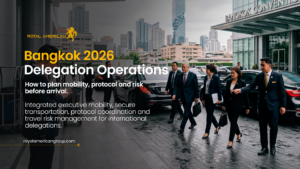
Major International Meetings Are Operational Missions, Not Business Trips
Every year, the IMF and World Bank Group Annual Meetings bring together finance ministers, central bank governors, multilateral organizations, sovereign wealth funds, institutional investors, family offices, development agencies, and corporate leaders from across the globe.
In 2026, Bangkok will become the center of this international financial agenda.
For participating delegations, however, attending the meetings is only one part of the mission.
The greater challenge is coordinating dozens—or sometimes hundreds—of executive movements across airports, hotels, conference venues, government offices, embassies, private meetings, and official receptions while maintaining punctuality, discretion, and operational continuity.
The organizations that perform best during events of this scale rarely depend on logistics alone.
They rely on integrated operational planning.
Delegation Operations Begin Weeks Before Departure
Many organizations concentrate their planning on conference registration, hotel reservations, and travel arrangements.
These activities are necessary, but they represent only the administrative layer of participation.
Operational preparation begins much earlier.
Successful delegations establish a framework that aligns travel, mobility, protocol, communications, executive priorities, and contingency planning before anyone boards a flight.
Early preparation allows teams to identify operational dependencies, clarify responsibilities, and reduce uncertainty once the delegation arrives in Bangkok.
The objective is to create an environment where leaders can focus entirely on policy discussions, negotiations, and institutional priorities.
Executive Mobility Supports Institutional Objectives
International delegations rarely move as a single group.
Ministers, governors, executive directors, advisors, protocol officers, technical specialists, interpreters, communications teams, and administrative personnel often operate simultaneously across different locations.
This creates a complex mobility environment that cannot be managed effectively through ad hoc transportation.
Executive mobility should be designed around the delegation’s operational objectives.
That includes coordinating:
- Airport arrivals and departures
- Executive transportation schedules
- Hotel operations
- Bilateral meeting logistics
- Venue access procedures
- Executive support vehicles
- Parallel itineraries
- Last-minute schedule changes
Reliable mobility protects the delegation’s agenda as much as it protects individual travelers.
Protocol Coordination Is Essential to Operational Success
Protocol is frequently associated with diplomatic etiquette.
In reality, it is a critical operational discipline.
Every official arrival, executive reception, bilateral meeting, and high-level engagement follows established procedures that influence timing, vehicle movements, access permissions, and executive flow.
Effective protocol coordination aligns:
- Arrival sequencing
- VIP reception procedures
- Credential verification
- Vehicle positioning
- Executive escorts
- Official access routes
- Meeting transitions
When protocol is integrated into operational planning, delegations move efficiently between engagements without unnecessary delays or confusion.
Travel Risk Management Should Inform Every Operational Decision
Bangkok offers world-class hospitality and event infrastructure, but any global gathering involving thousands of senior officials creates an evolving operating environment.
Traffic conditions fluctuate throughout the day.
Security perimeters change.
Large public events may affect mobility.
Infrastructure disruptions or severe weather can influence transportation planning.
Travel Risk Management provides the situational awareness necessary to adapt to these changes.
A comprehensive planning process should evaluate:
- Current destination intelligence
- Executive exposure
- Transportation reliability
- Alternative routes
- Local security developments
- Medical support availability
- Communication procedures
- Business continuity priorities
The goal is not to eliminate uncertainty.
It is to reduce its operational impact.
Parallel Agendas Require Centralized Coordination
One of the defining characteristics of international financial meetings is the number of simultaneous activities taking place.
While one delegation member attends a ministerial session, another may participate in a bilateral meeting, while communications teams engage with media and advisors coordinate future engagements.
Without centralized operational coordination, even minor schedule adjustments can create cascading delays throughout the delegation.
Successful organizations establish a single operational picture that provides visibility into:
- Executive locations
- Transportation status
- Meeting schedules
- Route conditions
- Operational priorities
- Real-time changes
This shared awareness allows decisions to be made quickly without disrupting the overall mission.
Communication Is as Important as Transportation
Transportation alone does not keep delegations moving.
Information does.
Operational communication should ensure that the right people receive the right information at the right time.
This includes:
- Executive offices
- Protocol teams
- Transportation coordinators
- Security personnel
- Administrative staff
- Event organizers
Clear communication reduces unnecessary interruptions while allowing leadership to concentrate on strategic discussions rather than logistical details.
Flexibility Is a Strategic Advantage
Even the most carefully planned itineraries change.
Meetings extend beyond their scheduled time.
Additional diplomatic engagements are added.
Traffic conditions evolve.
Venue access procedures are modified.
Organizations that build flexibility into their operational framework respond more effectively without compromising executive schedules.
This flexibility is supported through:
- Alternative transportation plans
- Backup routing
- Reserve operational resources
- Decision-making protocols
- Continuous monitoring
Rather than reacting to disruption, mature organizations adapt with confidence.
Delegation Operations Reflect Institutional Reputation
Every operational detail contributes to how an institution is perceived.
Professional transportation.
Punctual arrivals.
Seamless meeting transitions.
Well-coordinated protocol.
Responsive operational support.
Collectively, these elements reinforce professionalism and organizational credibility.
Delegation operations are therefore not only logistical responsibilities—they are part of the institution’s public and diplomatic presence.
Integrated Planning Creates Operational Confidence
Organizations attending Bangkok 2026 will operate in an environment where leadership schedules are demanding, movements are continuous, and operational variables evolve throughout the day.
Managing these challenges requires more than transportation providers or isolated security measures.
It requires a coordinated framework where executive mobility, protocol coordination, travel risk management, communication, and operational oversight work together.
This integrated approach reflects the operational philosophy of Royal American Group, supporting governments, central banks, multinational corporations, family offices, financial institutions, and international organizations participating in complex global events.
The objective is simple: enable leadership to remain focused on decisions while operational teams manage the complexity behind every movement.
Preparing for Bangkok 2026
Organizations planning to attend the IMF and World Bank Group Annual Meetings 2026 should begin operational planning well before arrival.
Early preparation improves flexibility, strengthens coordination, reduces operational uncertainty, and supports a more efficient experience for executives and delegations throughout the event.
Royal American Group provides integrated support for executive mobility, delegation transportation, protocol coordination, secure transportation, and travel risk management for organizations participating in Bangkok 2026.
To learn more about our dedicated operational support for the Annual Meetings, visit:
👉 https://imfbangkok2026.royalamericangroup.com
Conclusion
Successful participation in the IMF and World Bank Group Annual Meetings depends on far more than attending scheduled sessions.
It depends on ensuring that every executive movement, protocol requirement, communication flow, and operational decision supports the broader mission of the delegation.
Organizations that invest in integrated operational planning arrive in Bangkok with more than a travel itinerary.
They arrive with the confidence that leadership can focus on diplomacy, financial policy, and strategic engagement while every aspect of mobility, coordination, and risk is managed with precision.
In today’s international environment, that operational confidence has become a strategic advantage.