
 20th July 2026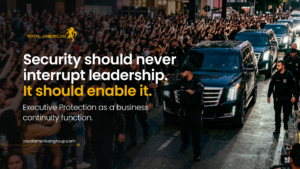
Executive Protection Has Evolved Beyond Personal Security
For many organizations, Executive Protection is still associated with visible bodyguards, armored vehicles, or emergency response.
While these capabilities remain important in specific situations, they represent only one part of a much broader discipline.
Today, organizations operating internationally face a different challenge.
Executives are expected to lead across multiple countries, attend strategic meetings, negotiate partnerships, represent their organizations publicly, and make critical decisions while operating in increasingly complex environments.
The greatest threat is not always a direct physical incident.
It is the interruption of leadership.
When leadership loses mobility, situational awareness, or the ability to make timely decisions, business continuity begins to deteriorate.
Modern Executive Protection exists to prevent exactly that.
Leadership Is a Critical Business Asset
Every organization identifies critical assets.
Technology infrastructure.
Financial systems.
Supply chains.
Intellectual property.
Yet one of the most valuable assets is often overlooked: leadership itself.
Executives carry institutional knowledge, strategic relationships, decision authority, and organizational credibility.
Their ability to operate directly influences negotiations, client relationships, investor confidence, regulatory engagement, and organizational performance.
Protecting executives therefore means protecting the organization’s ability to function.
Executive Protection should be viewed as an investment in operational continuity—not simply as a security expense.
Executive Risk Extends Far Beyond Physical Threats
The concept of executive risk has changed dramatically over the past decade.
Today’s executives face multiple layers of exposure simultaneously:
- Complex international travel
- Political demonstrations
- Large public events
- Digital exposure through social media
- Cybersecurity risks during travel
- Reputational visibility
- Infrastructure disruptions
- Operational uncertainty
These risks rarely exist independently.
They interact.
A transportation delay can affect media appearances.
A public demonstration may alter executive movements.
A cyber incident can disrupt negotiations.
A security concern can force last-minute operational changes.
Executive Protection today requires understanding how these variables influence executive performance—not simply personal safety.
Executive Protection Supports Business Continuity
Business continuity is commonly associated with disaster recovery, crisis management, and operational resilience.
However, continuity also depends on maintaining leadership capability.
An executive unable to reach a board meeting, delayed during a critical negotiation, or forced to alter strategic priorities because of preventable operational issues creates consequences throughout the organization.
Modern Executive Protection supports continuity by protecting:
- Executive availability
- Operational schedules
- Decision-making capacity
- Secure mobility
- Leadership confidence
- Organizational stability
In this context, protection becomes a strategic business function rather than an isolated security activity.
Preparation Matters More Than Response
The most effective Executive Protection programs spend far more time preparing than reacting.
Preparation begins well before travel.
It includes:
- Protective intelligence
- Destination risk assessments
- Executive itinerary analysis
- Secure transportation planning
- Route validation
- Communication protocols
- Contingency planning
This preparation allows organizations to anticipate challenges instead of improvising under pressure.
The objective is not simply responding to disruption.
It is reducing the likelihood that disruption affects executive performance in the first place.
Executive Mobility Is Part of Protection
Executive Protection cannot be separated from mobility.
Every movement creates operational exposure.
Airport arrivals.
Hotel transfers.
Corporate meetings.
Public appearances.
Private events.
International conferences.
Each transition introduces new variables that require coordination.
Well-designed executive mobility programs combine:
- Secure transportation
- Real-time operational monitoring
- Dynamic route planning
- Protective intelligence
- Local situational awareness
- Continuous communication
Mobility becomes one of the most important layers supporting executive continuity.
Protective Intelligence Enables Better Leadership Decisions
One of the most valuable components of Executive Protection is information.
More specifically, actionable intelligence.
Executives do not need constant alerts.
They need context.
Protective intelligence transforms information into operational awareness by answering questions such as:
- What has changed since planning?
- How does this affect today’s agenda?
- Should transportation be adjusted?
- Does public exposure require additional precautions?
- Are contingency plans necessary?
This allows executives to continue focusing on business objectives while operational teams monitor changing conditions.
Security becomes an enabler of leadership—not a distraction from it.
Executive Protection Is Most Effective When It Is Almost Invisible
One of the defining characteristics of mature Executive Protection programs is discretion.
The objective is not to create visible security.
The objective is to create operational confidence.
When protection is integrated successfully:
Executives arrive on time.
Meetings proceed without interruption.
Travel remains predictable.
Operational decisions happen smoothly.
Business objectives remain the primary focus.
The absence of disruption is often the greatest indicator of success.
Why Executive Protection Should Be Embedded Into Corporate Strategy
Organizations increasingly recognize that Executive Protection cannot remain an isolated department.
It must connect with:
- Enterprise risk management
- Business continuity planning
- Travel Risk Management (TRM)
- Crisis management
- Executive mobility
- Corporate governance
- Duty of care programs
This integrated approach allows organizations to support leadership consistently across countries, events, and operational environments.
Rather than reacting to isolated incidents, organizations build systems that enable executives to operate with confidence regardless of complexity.
Executive Protection Is Ultimately About Organizational Performance
Organizations often evaluate Executive Protection by asking:
“Did anything happen?”
A more strategic question is:
“Were executives able to perform at their highest level because operational risk was effectively managed?”
When Executive Protection is successful:
Leadership remains focused.
Schedules remain intact.
Business relationships continue uninterrupted.
Operational confidence increases.
Stakeholders experience continuity.
This is business value—not simply security value.
Why Organizations Are Rethinking Executive Protection
As international business becomes more interconnected, executive travel grows more complex, and public visibility increases, organizations are redefining what Executive Protection means.
The conversation is shifting from physical protection toward operational enablement.
This reflects the operational philosophy of Royal American Group, where Executive Protection integrates secure mobility, protective intelligence, travel risk management, and operational coordination into a unified framework that supports leadership before, during, and after every mission.
Security should never interrupt leadership.
It should enable it.
Conclusion
The purpose of Executive Protection is not to shield executives from the world.
It is to ensure they can continue leading effectively within it.
Organizations that recognize Executive Protection as a business continuity function gain more than increased security.
They strengthen resilience.
Improve decision-making.
Protect organizational reputation.
Support executive performance.
And maintain continuity when operating conditions become uncertain.
In today’s global business environment, that capability is no longer optional.
It has become a competitive advantage.