
 6th October 2026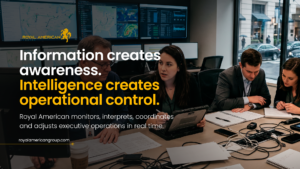
Modern Security Operations Do Not Suffer From a Lack of Information
Executive operations today generate an extraordinary amount of information.
Traffic platforms provide live congestion data. Government agencies issue security advisories. Weather services track developing conditions. News organizations report demonstrations and political developments. Event organizers communicate access changes. Local teams provide observations from the ground.
For corporate security teams, the challenge is rarely obtaining another data point.
The challenge is determining what that information means for the mission right now.
A road closure ten miles away may be irrelevant. A smaller disruption affecting the executive’s next movement may require immediate attention.
A demonstration somewhere in a major city does not automatically justify changing an itinerary. But a change in the demonstration’s location, direction, or impact on a critical travel corridor could materially alter the operation.
That distinction defines the difference between monitoring and real-time intelligence.
Monitoring tells an organization that something changed.
Operational intelligence determines whether the change matters, what it could affect, and whether action is required.
For Royal American Group, that distinction sits at the center of modern executive operations.
Monitoring Is the Beginning, Not the Capability
Real-time monitoring is essential.
Organizations supporting executives across international environments need visibility into changing conditions that could affect mobility, security, schedules, and business continuity.
But visibility alone does not create control.
Imagine an executive traveling between an airport, hotel, corporate meeting, and evening event. During the day, several developments occur simultaneously:
Traffic increases unexpectedly around the next venue.
A public gathering begins nearby.
The afternoon meeting extends by 40 minutes.
The original vehicle positioning plan is now misaligned with the revised schedule.
None of these developments necessarily constitutes a crisis.
Together, however, they change the operational picture.
A monitoring platform can identify individual variables. A mature security operation must understand their combined effect on the executive agenda.
That requires interpretation.
Real-Time Intelligence Must Answer: “What Does This Mean for Us?”
This is where protective intelligence becomes operational.
Executives do not need every security alert, traffic notification, social media update, or infrastructure report.
They need decision-relevant information.
A useful intelligence process continuously asks:
What changed?
Does it affect the executive, route, venue, schedule, or mission?
How significant is the change?
Does the current plan remain appropriate?
What alternatives are available?
Does someone need to make a decision now?
This filtering process matters because excessive information can become its own operational problem.
When teams receive too much undifferentiated data, they spend valuable time determining what deserves attention. During high-pressure operations, that creates cognitive friction precisely when clarity matters most.
The objective of real-time intelligence is therefore not maximum information.
It is maximum relevance.
Intelligence Without Operational Context Is Incomplete
To interpret changing conditions effectively, a security team must understand more than the external environment.
It must understand the mission.
Consider two executives traveling through the same city on the same day.
One has a flexible internal meeting that can easily be delayed.
The other is traveling to a time-sensitive government engagement involving multiple stakeholders.
The external risk environment may be identical.
The operational implications are not.
Real-time intelligence therefore requires context about:
- the executive profile;
- mission objectives;
- critical meetings;
- public exposure;
- timing dependencies;
- transportation resources;
- primary and alternative routes;
- venue access;
- contingency options.
This is why executive security cannot operate separately from executive mobility and agenda planning.
Risk only becomes meaningful when placed in context.
The Next Layer Is Decision Support
Once information has been interpreted, another question emerges:
What should the operation do about it?
This is where many monitoring models stop too early.
An alert may reach the security team, executive assistant, transportation provider, or traveler. But if nobody has translated that alert into an operational recommendation, the decision burden remains with people who may not have the necessary context.
Effective security decision support closes that gap.
Depending on the circumstances, the appropriate response may be to maintain the original plan.
In other cases, it may involve adjusting departure time, changing a route, repositioning transportation, modifying an arrival procedure, increasing awareness around a venue, or activating a previously established contingency.
The purpose is not to change plans every time conditions fluctuate.
That would create instability rather than security.
The objective is to make proportionate adjustments when the operational picture justifies them.
Command Coordination Turns Decisions Into Action
Even the right decision has limited value if the organization cannot execute it efficiently.
Executive operations frequently involve multiple stakeholders:
- corporate security;
- executive offices;
- drivers;
- protection personnel;
- event teams;
- local partners;
- hotels;
- aviation or airport support;
- client leadership.
A schedule change can affect several of these groups simultaneously.
If each stakeholder receives different information—or receives the same information at different times—the operation begins to fragment.
This is why command coordination is a critical layer of real-time executive support.
The goal is to maintain a shared operational picture, establish decision authority, communicate changes to the people who need them, and verify that adjustments have been executed.
Command coordination connects intelligence to action.
Without it, organizations may know exactly what is happening and still fail to respond coherently.
Royal American Group’s Role: Monitor, Interpret, Coordinate, Adjust
This is the distinction Royal American Group brings to executive operations.
The role is not limited to supplying transportation or providing personnel.
Royal American Group works to connect four operational functions.
Royal American Group monitors.
Changing security, mobility, infrastructure, event, and environmental conditions are followed throughout the mission according to operational requirements.
Royal American Group interprets.
Information is evaluated against the executive’s actual agenda, movement plan, and operating environment. The objective is to identify what matters rather than simply forwarding alerts.
Royal American Group coordinates.
Transportation, protection resources, local partners, operational teams, and relevant client stakeholders can be aligned around the same operational picture.
Royal American Group adjusts in real time.
When changing conditions justify action, the operation can adapt through coordinated changes to movement, timing, routing, positioning, or contingency execution.
This model shifts security from passive awareness to active operational support.
Protecting the Agenda, Not Only the Movement
Executive transportation is sometimes evaluated one transfer at a time.
Was the vehicle ready?
Did the executive arrive?
Was the transfer completed safely?
Those are important questions, but they do not capture the full mission.
An executive agenda is an interconnected sequence of commitments.
A delayed airport arrival affects the hotel transfer. That affects the first meeting. The first meeting affects the next departure. A late departure can place the executive into a different traffic or security environment than originally planned.
Small changes can become cascading disruptions.
Real-time operational intelligence therefore protects something larger than an individual journey.
It protects agenda integrity.
That means understanding how one decision influences what happens two or three movements later.
For leadership teams, this is where security creates direct business value.
Real-Time Control Does Not Mean Constant Intervention
A sophisticated security operation should not create unnecessary friction.
The objective is not to continually modify an executive’s itinerary or surround routine movements with excessive security measures.
Real-time control means maintaining enough visibility and coordination to intervene when intervention adds value.
Sometimes the best operational decision is to make no change at all.
If conditions remain within acceptable parameters, the executive should continue with minimal interruption.
This disciplined approach is important to Royal American Group’s positioning.
Security should support the mission, not become the mission.
The strongest operations often feel seamless to the executive precisely because significant monitoring and coordination are happening in the background.
Why Local Intelligence Still Matters in a Global System
Global visibility is valuable, but executive operations happen locally.
A global alert may identify a developing situation. Local knowledge helps determine how that situation affects a specific district, route, venue, or movement.
This is particularly important in international operations, where cultural context, infrastructure behavior, regulations, and local operating practices differ significantly.
Effective intelligence therefore combines broader situational awareness with local operational understanding.
That combination helps organizations avoid two common mistakes: underreacting because a global risk rating appears stable, or overreacting because an isolated alert lacks local context.
The objective is proportionate decision-making based on the actual environment.
Major Events Make Real-Time Coordination Even More Important
International conferences, major sporting events, financial summits, roadshows, and other high-visibility gatherings create particularly dynamic environments.
Transportation demand increases.
Security perimeters change.
Access credentials become critical.
Crowd patterns shift throughout the day.
Executive schedules become compressed.
Media visibility may increase.
A movement plan validated in the morning may need adjustment several hours later.
In these environments, static planning is insufficient.
Strong preparation establishes the baseline. Real-time intelligence keeps that baseline relevant after the operation begins.
For sponsors, delegations, executives, corporate groups, and international organizations, this can be the difference between isolated transportation services and a genuinely coordinated event operation.
Real-Time Intelligence Strengthens Travel Risk Management
Travel Risk Management is sometimes treated primarily as a pre-travel discipline.
Destination assessment, traveler briefing, insurance, emergency contacts, and itinerary review all happen before departure.
They are essential.
But risk does not stop evolving once the aircraft takes off.
Modern Travel Risk Management needs continuity between pre-travel preparation and live operational support.
The pre-travel assessment establishes expectations.
Real-time monitoring tests those expectations against current conditions.
Interpretation identifies meaningful deviations.
Decision support determines whether action is required.
Coordination implements the response.
Post-operation review captures what should improve next time.
Together, these elements create a continuous risk-management cycle rather than a one-time assessment.
Real-Time Intelligence Also Supports Duty of Care
Duty of Care is stronger when an organization can do more than warn travelers about risk.
A mature framework should help the company maintain awareness of material changes and provide an appropriate mechanism for support when circumstances evolve.
For executive travel, that may mean understanding where critical personnel are operating, what conditions could affect them, which resources are available, and who can authorize operational changes.
This is not about eliminating uncertainty.
No security provider can guarantee that.
It is about improving the organization’s ability to make informed, proportionate decisions as uncertainty develops.
That is a more realistic—and more operationally useful—definition of preparedness.
The Difference Between a Vendor and an Operational Partner
This model also changes how organizations should evaluate security and mobility providers.
A vendor fulfills a request.
An operational partner understands the mission.
A vendor reports a problem.
An operational partner helps interpret its impact.
A vendor executes an assigned movement.
An operational partner understands how that movement connects to the wider agenda.
A vendor waits for new instructions when the plan changes.
An operational partner has the coordination structure required to support adaptation.
For organizations managing high-value executive missions, that difference becomes increasingly important.
Royal American Group’s objective is to operate as an extension of the client’s security, mobility, and leadership-support structure—providing continuity between planning and live execution.
What Organizations Should Expect From Real-Time Executive Operations
A mature operational model should create clarity across four layers.
First, visibility: the organization needs awareness of relevant conditions.
Second, interpretation: information must be evaluated against the actual mission.
Third, decision support: teams need to understand whether the changing environment requires action.
Fourth, coordination: when a decision is made, the resources surrounding the executive must move together.
Removing any one of these layers weakens the system.
Monitoring without interpretation creates noise.
Interpretation without authority creates hesitation.
Decisions without coordination create fragmentation.
Coordination without visibility becomes reaction.
Effective executive operations connect all four.
Frequently Asked Questions
What is real-time intelligence in executive operations?
Real-time intelligence is the continuous process of monitoring relevant conditions, interpreting their impact on an executive mission, and using that analysis to support operational decisions while the mission is underway.
How is real-time intelligence different from monitoring?
Monitoring identifies changes. Intelligence interprets their relevance. Operational control goes further by connecting that interpretation to decisions, coordination, and execution.
What is protective intelligence?
Protective intelligence focuses on identifying and assessing information that could affect people, assets, movements, or operations. In executive travel, its value comes from translating information into practical implications for the mission.
Why is command coordination important for executive protection?
Executive operations can involve transportation, protection teams, executive offices, venues, local partners, and other stakeholders. Command coordination helps keep these groups aligned when schedules or conditions change.
Can real-time intelligence prevent every incident?
No. No monitoring or security system can eliminate all risk. Its purpose is to improve awareness, reduce avoidable exposure, support faster decisions, and strengthen the organization’s ability to adapt.
Does every executive trip require real-time operational monitoring?
Not necessarily at the same level. Support should be proportionate to the traveler profile, mission importance, destination, public exposure, itinerary complexity, and current risk environment.
How does real-time intelligence support business continuity?
It helps organizations identify developments that could disrupt leadership schedules or critical operations early enough to consider alternatives and coordinate adjustments before the impact expands.
From Information to Operational Control
The future of executive security is not defined by access to more data.
Most organizations already have more information than they can effectively consume.
The advantage comes from knowing which information matters—and having the operational structure to act on it.
That is why Royal American Group approaches real-time intelligence as part of a broader executive operations capability.
Monitor the environment. Interpret the implications. Coordinate the response. Adjust when necessary.
The result is security that does more than observe risk.
It supports leadership while the mission is moving.
Conclusion: Intelligence Creates Value When It Changes the Operation
Real-time monitoring answers an important question:
What is happening?
But executive operations require several more:
What does it mean for this mission? What should change? Who needs to act? How do we execute without disrupting the agenda?
Those questions transform information into intelligence and intelligence into operational control.
For global companies, international organizations, delegations, and leadership teams operating in complex environments, that capability is increasingly important.
Because protecting an executive is not only about responding to threats.
It is about maintaining the clarity, coordination, and mobility that allow leadership to continue operating when the environment changes.
Royal American Group supports executive protection, secure mobility, real-time intelligence, and operational coordination for organizations operating in complex environments worldwide.