
 17th November 2026
Introduction
Global executive mobility involves far more than arranging transportation between destinations. For organizations operating across multiple cities and countries, executive movements can depend on changing schedules, local conditions, transportation availability, security considerations and a wide network of people responsible for keeping the agenda on track.
An executive may have several meetings in one day, travel between airports and corporate facilities, attend a major international event and continue to another destination within a limited timeframe. Each movement has its own requirements, yet all movements remain connected to the executive’s broader business agenda.
When conditions change, the consequences can extend beyond transportation. A delayed arrival may affect a meeting, a venue access restriction may require a revised approach, and a change in local conditions may prompt a reassessment of the planned movement. The ability to recognize these developments and coordinate an appropriate response becomes an important part of operational management.
This is where real-time Command & Control plays a significant role.
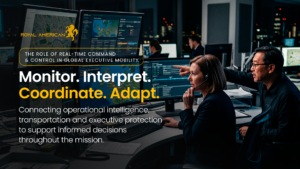
Command & Control provides a structured approach to maintaining operational visibility, interpreting relevant information, coordinating resources and supporting decisions as an operation unfolds. When applied to global executive mobility, it connects transportation, operational planning, protective intelligence and communication within a coordinated framework.
At Royal American Group, real-time operational coordination is a key part of the company’s approach to supporting executive movements and complex assignments. The focus is on understanding what is happening during an active operation, assessing how changes may affect the mission and coordinating adjustments according to the operational requirements.
This article explores how real-time Command & Control supports global executive mobility, why monitoring alone is insufficient, and how organizations can incorporate operational coordination into their approach to executive travel.
1. Understanding Command & Control in Executive Mobility
Command & Control refers to the processes, responsibilities and communication structures used to maintain oversight of an operation and coordinate decisions during execution.
In executive mobility, this can involve monitoring the status of transportation movements, maintaining communication with relevant teams, reviewing changing conditions and supporting adjustments when the original plan requires modification.
The precise structure depends on the operation. A single executive transfer may require a relatively straightforward coordination process. An international assignment involving several executives, multiple vehicles, different locations and a time-sensitive agenda may require more extensive oversight.
In both cases, the purpose is to connect operational information with the decisions and actions needed to support the mission.
A Command & Control framework may bring together several functions:
Operational monitoring. Maintaining awareness of relevant movement statuses, schedules and changing conditions.
Information assessment. Evaluating new information to understand its potential impact on the operation.
Communication coordination. Ensuring that the relevant people receive accurate updates through agreed channels.
Resource coordination. Supporting decisions involving vehicles, transportation partners, personnel and alternative arrangements.
Decision support. Providing the operational context needed by authorized decision-makers when a change requires approval.
Response coordination. Helping align actions across the operation after a decision has been made.
These functions work together. Monitoring may identify a delay, but assessment determines whether the delay affects a critical appointment. Communication ensures that the right people understand the situation, while coordination helps implement an appropriate response.
Command & Control therefore connects awareness to action. It creates a structure for managing the relationship between what is happening, what it means for the mission and what should happen next.
2. Why Global Executive Mobility Requires Continuous Visibility
Executive travel often takes place within a tightly managed schedule. Meeting times, airport transfers, venue access and onward travel can depend on one another. When an individual movement changes, the impact may extend across the itinerary.
This is particularly relevant during international travel, where unfamiliar locations, changing traffic conditions, airport procedures, local restrictions and time differences can introduce additional coordination requirements.
Consider an executive traveling from an airport to a hotel before attending several meetings. The initial transportation plan may account for the expected arrival time, the route and the meeting schedule. However, a flight delay, congestion or an unexpected access restriction could change the timing of the first transfer.
If that change affects subsequent appointments, the operation may require a review of the remaining schedule, communication with the executive’s office and adjustments to transportation arrangements.
Without a current understanding of the situation, teams may continue working from outdated information. This can lead to conflicting instructions, unnecessary waiting or decisions that fail to account for the broader itinerary.
Operational visibility helps reduce this uncertainty by keeping relevant information available as the mission progresses.
Depending on the operation and the agreed scope of support, this may include movement status, schedule changes, transportation availability, relevant local developments and updates from assigned personnel or providers.
Visibility must be proportionate to the mission. Each operation has different information requirements, and access to sensitive itinerary or passenger information should be restricted appropriately.
The goal is to maintain enough situational awareness to understand the operational picture and recognize when a development requires attention.
3. Monitoring Is Only the First Step
Monitoring provides information about an operation. Its value depends on how that information is interpreted and used.
A vehicle may be delayed, a pickup may be approaching its scheduled time or a route may be affected by changing traffic conditions. Each observation needs to be considered in context.
A delay of several minutes may have little impact on a flexible schedule. The same delay could be significant when the executive must reach a time-sensitive meeting or connect with another transportation arrangement.
The operational question is therefore more complex than whether something has changed. The team needs to understand what the change means for the mission.
This requires an assessment process that considers the reliability of the information, the timing of the affected movement, the dependencies within the schedule and the options available.
For example, a reported delay should be verified when possible. The team can then assess whether the executive’s next appointment remains achievable, whether another movement will be affected and whether a change needs to be communicated or approved.
The assessment should also distinguish between confirmed information and developing reports. Decisions made from incomplete or inaccurate information can introduce additional complications.
At Royal American Group, the distinction between monitoring and managing an operation is central to the value of real-time coordination. Monitoring supports awareness. Operational assessment connects that awareness to the mission, while coordination supports the practical steps needed to respond.
This approach helps keep decisions grounded in the current operational context rather than relying exclusively on the original plan.
4. Interpreting Information Within the Operational Context
Executive mobility generates information from multiple sources. Schedules, transportation updates, local traffic information, airport notifications, communications from field personnel and relevant security information may all contribute to the operational picture.
However, information is useful only when its relevance and limitations are understood.
A route update may indicate a potential delay, but its significance depends on the destination, the time available and the alternatives. A change in a meeting schedule may affect one executive’s transfer while leaving another movement unchanged. A local development may require further verification before it justifies an operational adjustment.
Information assessment should therefore consider several questions.
Is the information current and reliable? Which movement or stakeholder may be affected? Does the development create a timing conflict or change the original risk assessment? Are alternative arrangements available? Who needs to be informed, and who has authority to decide on the next step?
These questions help transform individual updates into a more coherent understanding of the operation.
The assessment process should also account for uncertainty. In a developing situation, the team may not immediately have all the information needed to make a final decision. In such cases, it may be appropriate to verify details, communicate the uncertainty and identify the conditions that would trigger further action.
This requires judgment. Excessive reactions to minor changes can disrupt an otherwise viable schedule, while overlooking meaningful developments can leave the operation poorly prepared.
The objective is to evaluate information in proportion to its potential impact and the needs of the mission.
5. Coordinating Transportation, Protection and Operational Planning
Global executive mobility often involves several connected service functions.
Transportation arrangements support physical movement. Executive Protection addresses the protection requirements defined for the assignment. Travel Risk Management considers relevant travel risks, while operational planning establishes the procedures, responsibilities and contingencies that guide execution.
These functions can become less effective when they operate without adequate communication.
A revised pickup time may affect the protection team’s movement plan. A change in venue access may influence arrival procedures. A disruption affecting one vehicle may require a review of the wider transportation schedule.
Command & Control provides a framework for bringing these considerations together.
When a change occurs, the relevant information can be shared with the appropriate participants, its impact can be assessed and the necessary adjustments can be coordinated within established responsibilities.
The precise coordination model depends on the assignment. Some clients may require transportation oversight and schedule management. Others may need a broader structure connecting transportation, protective personnel, risk information and client representatives.
It is important to establish these relationships before execution. Teams should understand which decisions they can make independently, which changes require client approval and how urgent issues should be escalated.
An integrated approach helps maintain alignment between the executive’s itinerary and the operational arrangements supporting it.
6. Decision-Making During Active Operations
Real-time operations require decisions to be made with the information available at the time. Some decisions are routine, while others may affect the wider agenda or require additional approval.
A defined decision-making structure helps teams respond without creating unnecessary confusion.
Routine adjustments may include confirming a revised pickup time or communicating a minor schedule change within agreed parameters. More significant changes may involve selecting an alternative route, arranging a replacement vehicle, modifying a sequence of movements or revising the timing of a critical appointment.
The appropriate decision-maker depends on the type of change and the responsibilities established before the operation.
A useful decision process includes four stages.
First, establish what has changed and verify the available information.
Second, assess the impact on the affected movement and any connected activities.
Third, identify feasible options and determine whether approval is required.
Fourth, communicate the decision to the relevant participants and confirm that the revised arrangements are understood.
This process provides structure while allowing the response to reflect the circumstances.
Decision-making should also account for safety and operational constraints. A schedule should not be preserved at the expense of appropriate safety measures. If the conditions no longer support the planned movement, the operation may need to pause, change or escalate for further assessment.
The purpose of Command & Control is to support informed, coordinated decisions. It does not remove the need for professional judgment or replace the authority of the people responsible for the mission.
7. Communication as the Link Between Information and Action
Communication is one of the foundations of effective operational coordination.
An assessment has limited value if the people responsible for implementing the decision do not receive the relevant information. Likewise, a decision can create further confusion if different participants receive inconsistent instructions.
A communication structure should define the primary contacts, the approved channels, the information that needs to be shared and the circumstances that require escalation.
During an executive movement, a schedule change may need to reach the transportation coordinator, the assigned driver, the executive’s representative and other personnel affected by the change. Each recipient may require different details, so communication should be tailored to operational responsibilities.
Updates should be clear and actionable. They should distinguish between a proposed adjustment and a confirmed change, identify the relevant movement and provide the information necessary for the recipient to respond.
Communication discipline is especially important when multiple locations or time zones are involved. Teams may be working with different local schedules, and delays in transmitting an update can create inconsistencies.
Sensitive information also requires appropriate handling. Executive itineraries, passenger details and operational arrangements should only be shared with authorized individuals through suitable channels.
A well-defined communication process helps ensure that decisions are translated into coordinated action and that the operational picture remains consistent across the relevant teams.
8. Managing Changes Without Losing Sight of the Wider Agenda
An executive’s schedule is often a connected sequence of commitments. Transportation decisions should therefore be evaluated in relation to the entire agenda rather than one isolated movement.
For example, moving a pickup earlier may resolve one timing issue while creating a conflict with another appointment. Changing a route may affect the arrival time at a second venue. Reassigning a vehicle may leave another passenger without the resource originally allocated.
A coordinated operation considers these dependencies before implementing a change.
This does not mean every adjustment requires a lengthy review. The level of assessment should reflect the potential impact and the urgency of the situation. A minor update may be handled through a standard process, while a significant disruption may require consultation across several functions.
Maintaining a view of the broader agenda helps identify which commitments are most sensitive to change and where flexibility exists.
It also helps teams communicate realistic expectations. When a revised schedule affects several activities, the relevant stakeholders need to understand the implications rather than receive a series of disconnected updates.
For organizations managing several executives or delegations simultaneously, this coordination becomes even more important. A change affecting one group may influence shared transportation resources, venue access or the timing of other movements.
Command & Control supports this broader perspective by connecting individual decisions to the operational priorities they are intended to serve.
9. Command & Control During International Events and Delegation Movements
International conferences, government meetings, corporate summits and major events create specific challenges for executive mobility.
Multiple delegations may arrive within a short period. Vehicles may need to use designated access points, movements may be subject to venue restrictions and schedules may change as meetings develop. Transportation requirements can also vary according to protocol, passenger profiles and the purpose of the visit.
These conditions make advance planning essential, but they also create a need for coordination during execution.
A movement plan should establish the intended sequence, resource assignments, pickup locations, communication procedures and contingency options. During the event, the responsible team may need to track progress, confirm arrivals, communicate timing changes and coordinate revised arrangements.
Where several movements are connected, updates should be assessed for their wider impact. A delayed arrival may affect a subsequent transfer, while a change in venue access may require coordination with the event organizer and transportation personnel.
Local knowledge can also be important. Access procedures, traffic conditions, local requirements and available resources vary by destination. The coordination structure should account for these differences rather than assuming that a single process will work identically everywhere.
Command & Control helps connect the advance plan with the conditions encountered during the operation. It supports a process in which information is reviewed as it becomes available and adjustments are coordinated according to the mission’s requirements.
10. The Relationship Between Command & Control and Travel Risk Management
Travel Risk Management helps organizations identify, assess and manage risks associated with travel. Command & Control supports the operational coordination needed when relevant conditions change during an active assignment.
The two functions are complementary.
Before travel, risk assessments can inform destination planning, transportation arrangements, communication procedures and contingency preparation. During execution, new information may require the team to review whether the existing arrangements remain appropriate.
For example, a change in local conditions may prompt a reassessment of a planned movement. The response could involve verifying the information, consulting the appropriate decision-maker and reviewing available transportation alternatives.
The decision should reflect the nature of the development, the reliability of the information and the requirements of the assignment.
Command & Control provides a structure for communicating the assessment and coordinating the resulting action. Travel Risk Management provides the broader framework for understanding travel-related risks and planning appropriate measures.
Organizations should define how these functions interact before an operation begins. They should also establish how new information is reported, who evaluates its implications and who can approve changes to the plan.
This connection helps keep operational decisions aligned with the organization’s risk management approach.
11. Technology, Human Judgment and Operational Visibility
Technology can support Command & Control by helping teams organize information, communicate updates and maintain visibility across multiple movements.
Depending on the operation, relevant tools may include transportation tracking systems, scheduling platforms, communication applications, operational dashboards and approved sources of local information.
These tools can make it easier to consolidate updates and identify discrepancies between the planned schedule and actual progress.
However, technology alone does not determine what an operational change means. Information may be incomplete, delayed or inconsistent. A status update may require verification, and a change that appears minor in a system may have a significant effect on the executive’s agenda.
Human judgment remains essential.
The operational team must interpret the available information, understand the context, consider the consequences and determine whether action is required. Technology supports that process by improving access to relevant information, while defined procedures help ensure that decisions are communicated and implemented consistently.
Organizations should also consider information security, access permissions, data accuracy and the reliability of their communication arrangements. Sensitive operational information needs appropriate safeguards, particularly when several providers or locations are involved.
The most useful approach is one in which technology, professional judgment and clear responsibilities work together to support operational awareness and coordinated action.
12. Measuring the Effectiveness of Operational Coordination
Organizations need a practical way to understand whether their coordination processes are working as intended.
Performance measures should reflect the operation’s objectives and the information that can be collected reliably. Depending on the assignment, useful indicators may include schedule adherence, the frequency of resource conflicts, the timeliness of status updates, the resolution of documented issues and compliance with established communication procedures.
These measures should be interpreted in context. A schedule deviation may result from external conditions beyond the team’s control. The relevant question is how the situation was identified, communicated and managed, rather than whether every movement occurred exactly as originally planned.
Post-operation reviews can provide additional insight.
Teams can compare the planned sequence with actual execution, identify changes that affected the agenda and assess whether the response process worked as intended. They can also examine whether responsibilities were clear, whether updates reached the right people and whether alternative arrangements were practical.
The findings should lead to specific improvements. These may include adjusting contingency plans, clarifying escalation responsibilities, improving schedule assumptions or refining communication procedures.
Performance review helps turn operational experience into better preparation for future assignments.
13. What Organizations Should Evaluate in a Command & Control Partner
Organizations considering external operational support should assess whether a provider can meet the coordination requirements of the mission.
The first step is to define the scope. Some assignments may require executive transportation and movement coordination. Others may need a broader structure involving protective support, travel risk information, group movements and coordination across multiple locations.
Organizations should confirm the provider’s actual capabilities and understand which services are included in the proposed arrangement.
Important evaluation areas include:
Operational visibility. What movement information can be monitored, and how is it made available to authorized stakeholders?
Information assessment. How are changes verified and evaluated for their impact on the operation?
Communication procedures. Are contact points, reporting channels and escalation responsibilities established in advance?
Resource coordination. How are changes to vehicles, schedules or transportation requirements managed?
Decision authority. Which adjustments can be coordinated directly, and which require client approval?
International requirements. How does the provider account for local conditions, destination-specific requirements and coordination with local resources?
Documentation and review. What information can be recorded, and how are lessons incorporated into future planning?
Organizations should also confirm service availability, geographic coverage, operating arrangements and applicable compliance requirements. These details should be documented and agreed before execution.
The objective is to establish a clear understanding of how the provider will support the operation, what responsibilities remain with the client and how coordination will work when circumstances change.
14. How Royal American Group Approaches Real-Time Operational Support
Royal American Group supports executive and corporate transportation, Executive Protection, Travel Risk Management, Duty of Care and related operational requirements.
Its approach recognizes that complex executive movements depend on coordination across planning, transportation, relevant intelligence and communication.
Real-time operational support helps maintain awareness of active movements, assess relevant changes and coordinate adjustments within the agreed scope of an engagement. The purpose is to connect the information available during execution with the decisions and actions required to support the mission.
For executive mobility, this can mean keeping transportation arrangements aligned with a changing agenda. For international assignments, it can involve coordinating movements across different locations and working with relevant local resources. For complex events, it can mean maintaining communication between the parties responsible for transportation and operational execution.
The specific structure depends on the assignment, the client’s requirements and the services agreed.
Royal American Group’s emphasis on monitoring, interpretation and coordination reflects an important principle: operational visibility is most useful when it supports informed action.
By connecting planning with real-time operational awareness, the company supports organizations seeking a more coordinated approach to executive mobility and complex transportation requirements.
Conclusion: Operational Control Requires More Than Visibility
Global executive mobility involves changing conditions, connected schedules and decisions that can affect the wider business agenda. Effective coordination requires a current understanding of the operation, the ability to interpret relevant information and a clear process for implementing appropriate adjustments.
Real-time Command & Control brings these elements together. It helps organizations maintain operational visibility, connect transportation and protective functions, communicate changes and support decisions throughout execution.
Its effectiveness depends on preparation. Responsibilities must be defined, communication procedures established, information sources assessed and decision authority clarified before the operation begins.
During execution, the team can use that structure to evaluate developments and coordinate the response. Afterward, documentation and review help improve the approach for future assignments.
For organizations managing executive travel, international delegations and complex corporate agendas, this integrated approach can support better-informed decisions and more coordinated operations.
Royal American Group supports executive mobility through transportation, protection, risk management and real-time operational coordination.
To discuss your organization’s requirements, visit www.royalamericangroup.com.