
 27th May 2026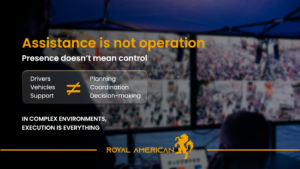
Why Vendor Selection Fails in International Events
In international events, organizations rarely fail due to lack of intent. They fail due to misalignment between expectation and capability.
Many companies believe they have secured the right support—until operations begin. Vehicles arrive. Personnel are present. Communication channels exist.
Yet under pressure, something becomes clear:
presence is not the same as control.
The root of this gap lies in a common misunderstanding—confusing assistance with operation.
Assistance vs. Operation: A Critical Distinction
At a surface level, assistance appears sufficient. It provides:
- Drivers
- Vehicles
- Security personnel
- Basic coordination
However, assistance operates reactively. It responds to requests.
Operation, on the other hand, is structured, proactive, and decision-driven. It includes:
- Integrated planning
- Real-time oversight
- Defined decision frameworks
- Coordinated execution across multiple variables
In high-exposure environments such as international events, assistance supports activity.
Operation controls outcomes.
The Hidden Risk of Low-Maturity Vendors
Low-maturity vendors often perform adequately in stable environments. The gap becomes visible only when complexity increases:
- Multiple executives moving simultaneously
- Tight schedules across locations
- Restricted access zones
- High media and public exposure
- Rapidly changing conditions
In these scenarios, limitations emerge:
- Lack of real-time visibility
- Inconsistent communication
- No clear escalation structure
- Reactive rather than anticipatory adjustments
The result is not necessarily a visible failure—but a gradual loss of control, leading to delays, inefficiencies, and increased exposure.
Evaluating Vendor Maturity: What Actually Matters
When selecting a provider for corporate event operations, organizations should move beyond surface-level criteria such as fleet size or geographic coverage.
Maturity is defined by how the vendor thinks, structures, and executes under pressure.
Key dimensions include:
1. Planning Capability
Does the vendor build structured operational plans, or simply execute predefined requests?
Look for:
- Route strategy (primary and secondary)
- Time window planning
- Integration with event schedules
- Pre-event risk assessment
Planning maturity determines whether operations are predictable or reactive.
2. Decision Architecture
Who makes decisions during the event—and how?
A mature provider defines:
- Decision ownership
- Escalation thresholds
- Response timelines
Without this, delays are inevitable.
3. Real-Time Control and Monitoring
Visibility is critical during international events.
Ask:
- How are movements monitored in real time?
- How are disruptions identified early?
- How are adjustments communicated and executed?
Vendors without real-time control operate based on outdated assumptions.
4. Communication Structure
Communication should enable decisions, not just updates.
Evaluate:
- Clarity of communication channels
- Frequency and relevance of updates
- Ability to filter noise into actionable information
Unstructured communication creates confusion under pressure.
5. Operational Redundancy
In high-risk environments, redundancy is not optional.
Assess whether the vendor provides:
- Backup vehicles and routes
- Alternative access strategies
- Contingency planning with defined triggers
Without redundancy, a single disruption can cascade into failure.
Critical Questions to Validate a Vendor
Beyond presentations and proposals, maturity is revealed through how a vendor answers specific questions.
Key validation questions include:
- How do you structure decision-making during live operations?
- What triggers a change in route or movement plan?
- How do you maintain control if communication is disrupted?
- What redundancy is built into executive movements?
- Can you describe how you handled a high-pressure event scenario?
Strong vendors answer with clarity and structure.
Weak vendors answer with generalities.
Signals of Risk During Procurement
Certain signals consistently indicate low operational maturity:
- Over-reliance on “experience” without process
- Vague descriptions of coordination
- Absence of real-time monitoring capabilities
- No defined escalation structure
- Focus on assets rather than systems
These signals often go unnoticed during procurement—but become critical during execution.
Why International Events Require Operational Thinking
International events introduce variables that amplify risk:
- Cross-cultural environments
- Regulatory differences
- Multi-location coordination
- High-profile stakeholders
- Increased unpredictability
In these contexts, fragmented or reactive support is insufficient.
Organizations need providers capable of operating as extensions of their own operational structure, not external vendors executing isolated tasks.
This is the model applied by Royal American Group, where security, mobility, and intelligence are integrated into unified frameworks designed for complex, high-exposure environments.
Conclusion: Maturity Determines Outcome
In international events, the difference between smooth execution and operational friction is rarely visible at the start.
It becomes clear only under pressure.
Organizations that select vendors based on assistance receive support.
Organizations that select based on operational maturity gain control.
And in environments where timing, visibility, and coordination define success,
control is not an advantage—it is a requirement.
Final Insight
The most important question is not:
“What services does this vendor provide?”
It is:
“Can this provider operate when complexity increases and conditions change?”
The answer to that question defines the outcome of the event—before it even begins.