
 4th August 2026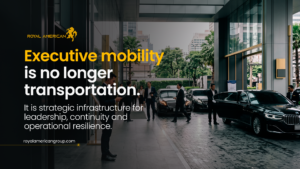
Executive Mobility Is No Longer Just About Transportation
For many organizations, executive mobility has traditionally been viewed as an administrative responsibility.
Flights are booked.
Hotels are confirmed.
Vehicles are scheduled.
The executive arrives.
That model no longer reflects the realities of global business.
Today’s executives operate in environments where travel is directly connected to strategic negotiations, investor relations, board governance, diplomatic engagement, major events, acquisitions, and business expansion. Every movement becomes part of a much larger operational ecosystem.
As organizations become more global, mobility is evolving into something much more significant:
Strategic infrastructure.
Just as companies invest in cybersecurity, cloud infrastructure, and business continuity planning, executive mobility has become a critical component of organizational resilience.
Leadership Moves the Business Forward
Business decisions rarely happen inside headquarters anymore.
Leadership travels continuously between countries, clients, government institutions, production facilities, conferences, investment forums, and board meetings.
Where executives go, strategic decisions follow.
When executive movement is interrupted, organizations experience consequences that extend well beyond transportation.
Delayed arrivals can affect negotiations.
Cancelled meetings may postpone investments.
Missed opportunities influence commercial relationships.
Operational uncertainty distracts leadership from strategic priorities.
Executive mobility therefore protects much more than people.
It protects the organization’s ability to execute its strategy.
Mobility Is an Operational System
Executive transportation is often evaluated by punctuality.
Strategic executive mobility should be evaluated by continuity.
Modern mobility programs combine multiple operational disciplines into one coordinated system.
These include:
- Executive transportation
- Route planning
- Protective intelligence
- Airport coordination
- Travel risk management
- Communication protocols
- Contingency planning
- Real-time operational monitoring
None of these functions create value independently.
Their effectiveness comes from operating as a single integrated framework.
Mobility is no longer a sequence of isolated trips.
It is an operational system that supports executive performance before, during, and after every journey.
Business Continuity Depends on Executive Availability
Business continuity is commonly associated with technology recovery, disaster response, and crisis management.
However, continuity also depends on leadership remaining available when organizations need them most.
Consider how often critical business activities rely on executive presence:
- Board meetings
- Investor presentations
- Regulatory discussions
- Government negotiations
- International conferences
- Mergers and acquisitions
- Customer relationships
- Strategic partnerships
If executives cannot move reliably, business continuity is compromised long before any formal crisis occurs.
Mobility is therefore not simply operational support.
It is part of the organization’s continuity strategy.
The Most Valuable Mobility Programs Reduce Friction
The purpose of executive mobility is not simply to move people efficiently.
Its purpose is to remove operational friction.
Executives already manage complex responsibilities.
Transportation uncertainty, communication gaps, access issues, and schedule disruptions create unnecessary cognitive load.
Well-designed mobility programs eliminate those distractions.
They allow executives to focus entirely on leadership while operational teams manage the complexity behind the scenes.
When mobility works correctly, it is almost invisible.
Executives simply experience reliable movement, predictable schedules, and uninterrupted agendas.
Executive Mobility Requires Continuous Situational Awareness
Global business environments change constantly.
Traffic patterns evolve.
Weather affects infrastructure.
Political demonstrations emerge.
Security conditions shift.
Major events alter access procedures.
Without continuous situational awareness, even carefully planned itineraries can quickly become outdated.
Modern executive mobility therefore relies on operational intelligence that continuously evaluates:
- Route conditions
- Infrastructure reliability
- Executive exposure
- Transportation timing
- Venue accessibility
- Environmental changes
Mobility decisions should never depend solely on yesterday’s plan.
They should reflect today’s operating environment.
Secure Transportation Is Only One Layer
Organizations often equate executive mobility with secure transportation.
While professional transportation is essential, it represents only one layer of a much broader operational capability.
Strategic mobility also requires:
- Integrated scheduling
- Executive itinerary analysis
- Airport logistics
- Multi-city coordination
- Local operational knowledge
- Protective intelligence
- Decision support
- Communication management
Transportation moves the executive.
Executive mobility enables the mission.
Mobility Must Adapt Without Losing Structure
No executive schedule remains unchanged.
Flights are delayed.
Meetings run longer.
Opportunities emerge unexpectedly.
Access restrictions evolve.
Effective mobility programs are designed to accommodate these changes without compromising operational control.
This requires:
- Alternative routing
- Flexible vehicle allocation
- Backup transportation resources
- Decision-making protocols
- Continuous operational oversight
Flexibility without structure creates improvisation.
Structure without flexibility creates rigidity.
Operational maturity combines both.
Executive Mobility Strengthens Organizational Resilience
Organizations increasingly invest in resilience.
They strengthen cybersecurity.
Diversify supply chains.
Improve crisis response.
Enhance governance.
Executive mobility should be viewed through the same lens.
Reliable mobility improves:
- Leadership availability
- Decision-making continuity
- Operational predictability
- Executive productivity
- Organizational confidence
These outcomes extend well beyond transportation.
They contribute directly to business resilience.
Mobility Is a Strategic Investment, Not an Operational Expense
One of the biggest shifts occurring inside multinational organizations is the recognition that executive mobility should no longer be evaluated solely through travel budgets.
Its true value is measured by:
- Reduced operational disruption
- Greater executive productivity
- Improved stakeholder confidence
- Better risk management
- Enhanced business continuity
- Stronger governance
The return on investment comes not from moving executives more cheaply.
It comes from enabling them to perform consistently in increasingly complex environments.
Executive Mobility Is Becoming a Competitive Advantage
Organizations operating internationally face growing complexity.
Major events.
Geopolitical uncertainty.
Infrastructure constraints.
Rapid business expansion.
Increasing executive travel.
Those capable of maintaining leadership continuity despite these variables gain a measurable competitive advantage.
This integrated approach reflects the operational philosophy of Royal American Group, where executive mobility combines secure transportation, travel risk management, protective intelligence, and operational coordination into a unified framework that supports leadership wherever business takes place.
Mobility is no longer about reaching the destination.
It is about ensuring leadership arrives prepared to perform.
Conclusion
Executive mobility has evolved far beyond transportation.
It has become a strategic infrastructure supporting leadership, protecting operational continuity, and enabling organizations to execute confidently in increasingly complex environments.
Companies that continue treating executive travel as a logistical function risk underestimating one of the most important components of modern business operations.
Those that invest in structured executive mobility gain something far more valuable than efficient transportation.
They gain continuity.
Resilience.
Operational confidence.
And the ability to keep leadership focused on what matters most—making decisions that move the business forward.