
 15th September 2026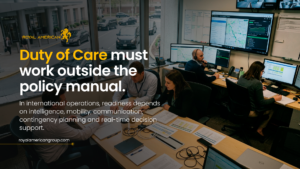
Duty of Care Is Often Strong on Paper and Weak in Execution
Most global organizations understand the concept of Duty of Care.
They have travel policies. Emergency contacts exist. Insurance is in place. Employees may receive destination advisories before departure. In some cases, executives and traveling teams are supported by corporate security or travel risk programs.
The problem is that Duty of Care often becomes fragmented between departments and disconnected from the actual conditions travelers face.
A policy may define responsibility, but it does not automatically create operational readiness.
An emergency number may exist, but it does not guarantee timely coordination.
A risk report may identify exposure, but it has little value if it does not change the travel plan.
For companies operating across borders, supporting senior leadership, or participating in high-profile international events, mature Duty of Care requires more than compliance. It requires a system capable of connecting intelligence, mobility, communication, decision-making, and contingency planning throughout the operation.
The gaps are often found not in what organizations intend to do, but in what they fail to operationalize.
1. Treating Duty of Care as a Travel Policy Instead of an Operating Capability
One of the most common mistakes is reducing Duty of Care to a written policy.
Policies are necessary. They create standards, define responsibilities, and establish expectations. But they are only the foundation.
International operations are dynamic.
Flights change. Road conditions deteriorate. demonstrations emerge. Severe weather affects infrastructure. Meetings move. Executives become more visible than expected. Communication networks can become unreliable.
A policy cannot interpret those conditions in real time.
Operational Duty of Care requires the organization to know how policy translates into decisions when the environment changes.
Who monitors conditions?
Who interprets the information?
Who can alter an itinerary?
Who coordinates transportation?
Who decides when a contingency should be activated?
If these questions are unanswered, Duty of Care may exist administratively while remaining weak operationally.
2. Assuming All International Travel Carries the Same Risk
Not every trip requires the same level of support.
A routine visit to a familiar commercial center is different from a senior executive attending a high-visibility summit. A technical team traveling to an operational site has a different exposure profile from a board delegation moving between diplomatic engagements.
Yet organizations sometimes apply one standard travel procedure across every traveler, destination, and mission.
This creates two problems.
The first is overreaction, where unnecessary measures create cost and friction.
The second is more serious: under-protection, where the support structure fails to reflect the actual exposure.
A mature Duty of Care framework considers factors such as:
- Traveler profile
- Destination conditions
- Purpose of travel
- Public visibility
- Criticality of the agenda
- Transportation environment
- Medical accessibility
- Current social and political conditions
The objective is not maximum security.
It is the appropriate level of support for the actual mission.
3. Focusing on the Destination but Ignoring Movement Between Locations
Travel risk discussions often focus heavily on the destination itself.
Is the city safe?
What is the crime level?
Are there demonstrations?
Those questions matter, but much of an executive’s exposure occurs during movement.
Airport arrivals, hotel transfers, trips between meetings, venue entrances, late-night departures, and movements through unfamiliar districts all create operational variables.
This is why executive mobility must be part of Duty of Care.
Companies should understand:
- Who is providing transportation
- Whether drivers and vehicles are properly vetted
- Which routes are planned
- What alternatives exist
- Whether airport pickup procedures are clear
- How movements will be monitored
- What happens when the schedule changes
A travel program that assesses the destination but ignores the movement environment is incomplete.
4. Having Intelligence Without Decision Criteria
Many companies receive security alerts.
Far fewer have a clear framework for deciding what those alerts mean operationally.
A protest alert, weather advisory, crime report, or infrastructure disruption can generate uncertainty if the organization has not defined how information should influence the mission.
The key questions are not simply:
“What is happening?”
They are:
“Does this affect our traveler?”
“Does it affect today’s route or schedule?”
“Does the risk justify a change?”
“Who has authority to approve that change?”
This is where Travel Risk Management becomes practical.
Intelligence should support decisions about agenda, mobility, posture, communications, and contingencies.
Without that connection, organizations collect information without improving control.
5. Relying on a Single Communication Channel
Communication failures can quickly expose weaknesses in an otherwise strong travel plan.
Many organizations assume the traveler will always have access to a mobile phone, messaging application, email, or local connectivity.
International operations can challenge that assumption.
Network congestion, roaming problems, battery failure, device loss, outages, or local disruptions may affect primary communication methods.
Duty of Care should therefore include communication redundancy.
Teams should understand:
- Primary communication channel
- Backup channel
- Check-in expectations
- Escalation procedures
- Who should be contacted first
- What happens if the traveler cannot be reached
The purpose is not to create unnecessary reporting.
It is to preserve coordination when normal communication fails.
6. Confusing an Emergency Contact With an Emergency Response Capability
Having a 24-hour telephone number is not the same as having a response capability.
This is an important distinction.
When an executive or team requires assistance, the organization must be able to move from notification to coordinated action.
That may involve transportation, local partners, medical support, security personnel, alternative lodging, route changes, or relocation planning.
A mature Duty of Care program therefore asks not only:
“Who can the traveler call?”
But also:
“What happens after the call?”
The quality of the response depends on access to reliable information, defined authority, vetted resources, and operational coordination.
7. Overlooking International Events as a Different Risk Environment
International conferences, major sporting events, financial summits, trade shows, diplomatic meetings, and executive roadshows create conditions very different from routine business travel.
They concentrate:
- Senior leadership
- Media attention
- Public crowds
- Transportation demand
- Security restrictions
- High-value targets
- Complex schedules
Cities may introduce temporary traffic patterns, controlled perimeters, accreditation requirements, road closures, or enhanced law-enforcement activity.
Hotels and airports may also experience exceptional demand.
Duty of Care planning for international events should therefore begin earlier and include event-specific intelligence, mobility planning, schedule redundancy, communications, and contingency support.
A normal travel process may not be sufficient for an abnormal operating environment.
8. Ignoring Schedule Risk
Organizations often assess physical threats but overlook the risks created by the agenda itself.
An executive schedule can become a source of exposure when it includes:
- Back-to-back meetings across distant locations
- Minimal transit buffers
- Late-night movements
- Predictable daily routines
- Multiple public appearances
- Tight airport connections
These are operational vulnerabilities.
Even without a security incident, a single delay can create cascading consequences across the remainder of the day.
Strong Duty of Care therefore protects the agenda, not only the traveler.
This means considering whether the itinerary is operationally realistic and whether sufficient flexibility exists if circumstances change.
9. Failing to Plan Medical Contingencies
Medical readiness is one of the most practical elements of international Duty of Care, yet it is sometimes reduced to travel insurance.
Insurance is important, but it does not answer operational questions during an urgent situation.
Organizations should understand which medical facilities are suitable, how the traveler would reach them, what insurance or documentation may be required, and who would coordinate the response.
For executives with demanding schedules or teams operating in unfamiliar environments, this preparation reduces decision-making time when speed matters.
Medical contingency planning does not assume an emergency will occur.
It ensures the organization does not have to build a response from zero if one does.
10. Forgetting the Digital Exposure of Executive Travel
Travel risk is no longer exclusively physical.
Executives routinely carry access to sensitive corporate information, email, financial data, proprietary documents, and internal systems.
Airports, hotels, conferences, public Wi-Fi networks, and unfamiliar charging or connectivity environments may increase cyber exposure.
A complete Duty of Care approach should therefore coordinate with corporate cybersecurity practices, including device updates, multi-factor authentication, secure connectivity, and appropriate handling of sensitive information.
The organization’s responsibility travels with the employee in both physical and digital form.
11. Treating Contingency Plans as Generic Documents
Many organizations can point to an emergency plan.
The more important question is whether that plan is relevant to the specific trip.
Effective contingency planning should consider actual operational scenarios.
What happens if the airport closes?
What happens if a route becomes inaccessible?
What happens if the hotel is no longer suitable?
What happens if an event is disrupted?
What happens if the executive must relocate?
A useful contingency framework establishes viable alternatives and clear activation criteria before disruption occurs.
The value of a Plan B is not that it exists.
It is that the organization knows when to use it.
12. Ending Duty of Care Once the Executive Arrives
Duty of Care does not end at hotel check-in.
Conditions can change throughout a journey.
A destination assessed as low risk before departure may experience new demonstrations, weather disruptions, crime patterns, infrastructure failures, or event-related restrictions while the traveler is already there.
This is why modern international operations require real-time monitoring and interpretation.
Royal American Group’s operating model focuses on this continuous layer.
Royal American Group monitors changing conditions, interprets how they affect the mission, coordinates the relevant resources, and supports adjustments when conditions require them.
The objective is not simply to respond when a problem becomes visible.
It is to preserve control before disruption reaches the executive agenda.
Duty of Care Is Ultimately About Decision Readiness
The strongest Duty of Care programs are not necessarily those with the longest policies.
They are the ones that make good decisions easier.
Before travel, the organization understands the operating environment.
During travel, teams maintain visibility.
When conditions change, decision authority is clear.
When a contingency becomes necessary, alternatives already exist.
After the operation, lessons can be incorporated into future planning.
This creates a continuous cycle of preparedness rather than a compliance exercise repeated for every trip.
Why This Matters for Corporate Governance and Business Continuity
Duty of Care affects more than traveler wellbeing.
It intersects with operational risk, corporate governance, reputation, executive performance, and business continuity.
An organization may have strong financial controls and sophisticated technology infrastructure, yet still expose critical personnel through poorly structured international travel.
That disconnect matters.
Leadership availability is a business dependency.
Employee safety is a corporate responsibility.
Operational readiness is a resilience issue.
For organizations operating internationally, these areas cannot be managed separately.
Duty of Care should function as part of a broader risk architecture connecting corporate security, travel, HR, legal, compliance, executive offices, and business continuity teams.
Download the Event & Travel Risk Preparedness Checklist
The easiest time to identify a Duty of Care gap is before the operation begins.
Royal American Group’s Event & Travel Risk Preparedness Checklist provides a structured framework for organizations preparing executives and teams for international travel, conferences, high-visibility events, and complex operating environments.
The checklist covers critical readiness areas including local intelligence, route planning, secure transportation, communications, medical contingencies, cyber hygiene, emergency contacts, relocation planning, and real-time monitoring.
Download the Event & Travel Risk Preparedness Checklist
https://marketing.royalamericangroup.com
Conclusion: Duty of Care Must Work Outside the Policy Manual
The most important Duty of Care failures are often not dramatic.
They are operational gaps that remain unnoticed until conditions become difficult.
An unvalidated transportation provider.
A missing backup route.
An unclear escalation process.
A security alert nobody translates into action.
A communication plan without redundancy.
A contingency that exists on paper but cannot be activated efficiently.
Individually, these may appear minor. Together, they determine whether the organization can maintain control when an executive or team is operating far from familiar systems.
Effective Duty of Care therefore requires more than compliance.
It requires continuous awareness, operational coordination, and decision readiness.
That is how organizations protect people without creating unnecessary friction—and how they support continuity wherever business takes them.