
 13th May 2026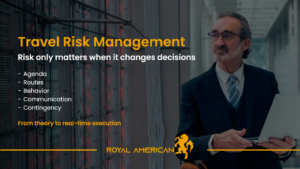
Why Travel Risk Management Often Fails in Practice
Many organizations have already adopted Travel Risk Management (TRM) frameworks. Policies are in place, risk reports are generated, and monitoring tools are active.
On paper, risk is identified, categorized, and tracked.
In practice, however, what determines the success of an operation is not the identification of risk—but the quality of the decisions made because of it.
The core issue is that TRM often remains theoretical:
- Reports that do not influence executive agendas
- Alerts that do not change routes
- Known risks that do not alter behavior
Executives do not operate in reports. They operate in real time, under pressure, with strategic priorities at stake.
This leads to a critical question:
How does risk translate into decision?
From Risk to Agenda: The First Point of Impact
The first place where TRM must become tangible is the executive agenda.
It is not only about where an executive will be—but when and under what conditions.
A well-integrated TRM approach directly influences:
- Timing of movements
- Sequencing of meetings
- Duration of exposure in public or high-risk environments
- Decisions between physical presence and alternative engagement
An agenda without risk integration is merely logistical.
An agenda shaped by TRM becomes an operational strategy.
Routes: Mobility as a Strategic Decision
Routes are often treated as operational details. In reality, they are one of the most critical exposure variables.
Applied TRM transforms mobility into a structured decision-making process:
- Defining primary and alternative routes
- Adjusting based on time, environment, and real-time conditions
- Avoiding areas of elevated exposure
- Aligning movement with critical agenda windows
The question is no longer “What is the fastest route?” but:
What is the most controlled and adaptable route right now?
This shift reduces uncertainty and increases operational resilience.
Behavior: The Human Layer of Security
Even with strong planning, executive behavior remains a decisive factor.
Exposure is often increased not by environment, but by interaction with it:
- Use of devices in vulnerable locations
- Predictable movement patterns
- Unfiltered engagement in public environments
- Excessive visibility in sensitive contexts
Effective TRM translates risk into practical behavioral awareness, without limiting executive autonomy.
Security is not only about where you are—it is also about how you operate within that environment.
Communication: Where Information Becomes Action
Without structured communication, TRM loses its operational value.
During travel, decisions depend on:
- Timely updates
- Interpretation of evolving conditions
- Clarity on what requires immediate action
Effective communication is not about volume—it is about precision.
It defines:
- Who receives what information
- When information becomes a decision trigger
- How escalation is handled
TRM succeeds when communication supports action—not when it overwhelms.
Contingency: When Planning Meets Reality
No plan remains unchanged in dynamic environments.
TRM becomes truly operational when contingency is clearly defined in advance.
This includes:
- Validated alternative routes
- Flexible scheduling options
- Protocols for rapid adjustment
- Clear decision triggers for activating alternatives
The key is not having options.
It is knowing when and why to use them.
When contingency is pre-defined, adaptation becomes controlled.
When it is improvised, exposure increases.
TRM as a Decision Support System
Executives do not need more information. They need better decisions under pressure.
Effective TRM functions as a decision-support system:
- Reducing ambiguity
- Anticipating scenarios
- Enabling faster adjustments
- Supporting confidence in uncertain environments
When properly integrated, TRM does not interfere with executive agendas—it enables them.
From Tool to Organizational Capability
Many organizations still treat TRM as a service or tool. More advanced organizations treat it as a core operational capability.
This means:
- Integration with leadership and operations
- Consistency across regions and roles
- Alignment with governance and duty-of-care frameworks
- Continuous learning from each operation
In this model, TRM evolves from reactive support into a structural component of global operations.
This approach reflects the operational philosophy of Royal American Group, where security, mobility, and intelligence are integrated to support real-time decision-making—not just risk analysis.
Conclusion: Risk Only Matters When It Changes Decisions
The most common failure in Travel Risk Management is not ignoring risk.
It is recognizing it—without acting on it.
TRM creates value only when it directly influences:
- Agenda
- Routes
- Behavior
- Communication
- Contingency
In other words, when it moves from theory into decision-making.
For executives operating in complex environments, this is not an advantage.
It is a requirement for operating with consistency, control, and confidence.