
 20th May 2026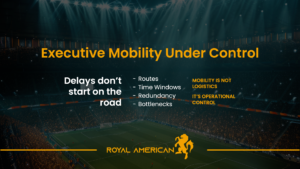
When Mobility Becomes a Critical Risk Variable
Mega-events like the 2026 FIFA World Cup redefine how cities function.
Infrastructure operates at maximum capacity. Traffic patterns become unpredictable. Security perimeters expand. Access points are restricted. At the same time, executives, sponsors, media teams, and stakeholders must move across cities with precision.
In this context, executive transportation is no longer a logistical function—it becomes a performance-critical operational system.
The real risk is not only delay. It is cascade failure:
- One late arrival affects multiple meetings
- One blocked route compromises an entire schedule
- One miscalculated transfer disrupts decision-making
Executive mobility under these conditions must be engineered, not improvised.
Understanding the 2026 World Cup Complexity
Unlike previous editions, the 2026 World Cup will span multiple countries, cities, and operational environments across North America. This introduces a new layer of complexity:
- Cross-border movements
- Varying security protocols
- Diverse infrastructure reliability
- Different urban congestion profiles
- Simultaneous high-density events
For executives moving between matches, meetings, and strategic engagements, mobility planning must operate with multi-layered coordination and real-time adaptability.
Routes: Designing for Control, Not Speed
In high-density environments, the fastest route is rarely the most reliable.
Executive mobility planning must prioritize control over speed. This requires:
- Predefined primary and secondary routes
- Real-time validation of route viability
- Avoidance of known congestion corridors
- Alignment with security perimeters and restricted zones
Routes should be selected based on predictability and adaptability, not just distance.
A controlled route allows for decision-making flexibility.
An optimized route without redundancy creates fragility.
Time Windows: The Invisible Layer of Mobility
Time is often treated as a fixed parameter. During mega-events, it becomes dynamic.
Effective executive mobility planning depends on understanding and controlling time windows:
- Pre-event congestion spikes
- Post-match traffic surges
- Security lockdown periods
- Media and VIP movement overlaps
Arriving “on time” is not enough. Executives must arrive within controlled time windows that absorb variability.
This requires:
- Built-in buffers aligned with real conditions
- Flexible scheduling logic
- Coordination with event timelines and security protocols
Time windows transform movement from reactive timing into strategic positioning.
Redundancy: The Core of Operational Resilience
In environments like the World Cup, disruption is not hypothetical—it is constant.
Redundancy is what prevents disruption from becoming failure.
This includes:
- Backup vehicles positioned strategically
- Alternative routes validated in advance
- Secondary access points to venues
- Contingency drivers and support teams
Redundancy is often misunderstood as inefficiency. In reality, it is operational insurance against unpredictability.
Without redundancy, a single point of failure can compromise the entire movement chain.
Bottlenecks: Identifying Where Operations Break
Every city under pressure develops bottlenecks.
During the World Cup, these are amplified:
- Stadium access corridors
- Airport arrivals and departures
- Hotel zones with concentrated VIP presence
- Security checkpoints and restricted perimeters
The key is not to react to bottlenecks—but to anticipate and design around them.
Effective planning identifies:
- Where delays are most likely to occur
- When those delays peak
- How to bypass or absorb them
Bottlenecks are not exceptions. They are predictable constraints that must be engineered into the plan.
Avoiding Cascade Delays and Performance Loss
Executive schedules during mega-events are tightly interconnected. A delay in one movement can trigger a chain reaction:
- Missed meetings
- Reduced negotiation time
- Compressed decision windows
- Increased stress and cognitive fatigue
This is where mobility directly impacts executive performance.
Controlled mobility ensures:
- Predictable arrivals
- Reduced decision pressure
- Maintained focus on strategic priorities
The goal is not just to move executives—but to protect their ability to perform.
Real-Time Control: The Missing Layer in Most Operations
Even the best plans degrade without real-time control.
During the 2026 World Cup, conditions will shift continuously. Effective operations require:
- Live monitoring of traffic and security conditions
- Continuous communication between teams
- Immediate adjustment capability
- Decision support aligned with executive priorities
Real-time control transforms mobility from static planning into dynamic execution.
Without it, organizations operate based on outdated assumptions.
Executive Mobility as a Strategic Capability
Organizations that operate successfully in environments like the World Cup do not treat transportation as a vendor service.
They treat it as a strategic capability—integrated with:
- Risk management
- Executive scheduling
- Security operations
- Decision-making frameworks
This integrated model reflects the approach of Royal American Group, where executive mobility is designed to support continuity, reduce exposure, and maintain control in complex, high-pressure environments.
Conclusion: Control Prevents Collapse
In mega-events, complexity is unavoidable. Congestion is inevitable. Pressure is constant.
What determines success is not speed—but control.
Organizations that invest in structured executive transportation planning, redundancy, and real-time coordination avoid cascade delays and protect leadership performance.
Those that rely on improvisation experience friction, disruption, and loss of control.
During the 2026 World Cup, mobility will not be a detail.
It will be a defining factor in operational success.