
 6th May 2026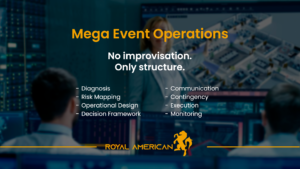
Why Mega Event Operations Fail Without Structure
Mega events concentrate exposure in ways few other environments do.
Executives, media attention, dense crowds, restricted access zones, and rapidly shifting conditions all converge simultaneously. The margin for error narrows, while the consequences of misalignment expand.
In these environments, improvisation is often misunderstood as agility. In reality, it is the primary source of operational failure.
Organizations that perform consistently under pressure do not rely on reaction. They rely on structured planning, controlled execution, and decision clarity.
This is the foundation of effective mega event operations planning.
Diagnosis: Defining What Cannot Fail
Every controlled operation begins with clarity—not logistics.
Before routes are mapped or teams are deployed, organizations must define what is truly critical:
- The purpose of the event
- The executives and stakeholders involved
- The moments that cannot be disrupted
- The acceptable level of risk
Without this diagnostic phase, planning becomes generic. And generic planning does not hold under pressure.
Strong corporate event operations are built around priorities, not activities. The focus is not on everything that will happen, but on what must not fail.
Risk Mapping: Turning Environment Into Intelligence
Mega events fundamentally alter the operating environment of a city.
Traffic patterns shift unpredictably. Security presence increases but becomes uneven. Access restrictions evolve. Protest activity or public disruption may emerge with little notice.
Effective event security planning requires more than awareness—it requires structured risk mapping that transforms uncertainty into decision-ready insight.
This includes:
- Geopolitical and social context
- Crime and security dynamics
- Infrastructure reliability
- Event-specific restrictions and access control
- Crowd density and movement behavior
Without this layer, organizations operate reactively. With it, they operate with informed anticipation.
Operational Design: Building Control Before Movement
Once the environment is understood, structure must follow.
Operational design defines how the system behaves before it is tested in real time. It includes:
- Primary and alternative movement routes
- Time buffers aligned with real conditions
- Controlled access points and credential validation
- Transportation strategy aligned with risk level
- Strategic positioning of teams
At this stage, the objective is not efficiency—it is control under variability.
Well-designed executive mobility planning ensures that every movement has logic, redundancy, and adaptability embedded within it.
Decision Framework: Eliminating Ambiguity Under Pressure
One of the most common causes of failure in mega event operations is not lack of planning—but lack of decision clarity.
When conditions change, organizations often hesitate—not because they lack information, but because they lack defined authority.
A structured decision framework answers:
- Who makes strategic decisions
- Who controls operational adjustments
- What triggers escalation
- When decisions must be made
In high-pressure environments, time is compressed.
And when decision ownership is unclear, time is lost.
Effective risk management for events is not about predicting disruption—it is about deciding faster and with clarity when disruption occurs.
Communication Structure: From Information to Action
Information alone does not create control.
During large-scale events, data flows constantly—traffic updates, security alerts, schedule changes, local developments. Without structure, this creates noise, not clarity.
A strong communication model ensures:
- Defined channels for different types of information
- Scheduled synchronization points
- Real-time updates with context, not raw data
- Clear escalation pathways
The objective is not to communicate more.
It is to enable decisions through communication.
Contingency Planning: Designing for Disruption, Not Avoiding It
In complex environments, disruption is not hypothetical. It is inevitable.
The difference between resilient and reactive operations lies in whether contingency is designed or improvised.
Effective travel risk management for events includes:
- Predefined route alternatives
- Flexible scheduling strategies
- Access restriction scenarios
- Security and medical response pathways
Every critical movement should be supported by:
- Plan A (primary execution)
- Plan B (validated alternative)
- Clear triggers for transition
When contingency is predefined, adaptation becomes controlled.
When it is improvised, exposure increases.
Execution: Coordination in Motion
Execution is where planning meets reality.
At this stage, success depends on alignment—not activity. Teams must operate under shared logic, communication must remain structured, and adjustments must follow defined protocols.
Execution is not the moment to create decisions.
It is the moment to apply them with discipline.
In high-exposure environments, even small deviations can cascade quickly. Structured execution prevents fragmentation and maintains operational integrity.
Real-Time Monitoring: Maintaining Control After Deployment
Once operations are in motion, visibility becomes the primary control mechanism.
Situations evolve rapidly during large events. Without real-time monitoring, organizations lose the ability to anticipate and adapt.
Effective monitoring enables:
- Early detection of disruptions
- Continuous validation of movement plans
- Timely adjustments before escalation
This is where executive travel security becomes dynamic rather than static.
Monitoring is not passive observation—it is active control of evolving conditions.
Post-Operation: Turning Experience Into Capability
The operation does not end when the event concludes.
Post-operation analysis transforms execution into long-term capability. It allows organizations to:
- Identify what worked under pressure
- Understand where friction occurred
- Evaluate decision timing and effectiveness
- Refine future operational models
Consistency is not built through repetition.
It is built through structured learning and iteration.
From Improvisation to Systematic Control
Planning mega event operations is not about increasing security presence. It is about building a system that supports leadership, enables decision-making, and maintains continuity under pressure.
This is the operating philosophy applied by Royal American Group, where security, mobility, and intelligence are integrated into a unified framework designed for high-exposure environments.
Organizations that rely on improvisation react to events.
Organizations that build structure control them.
Conclusion: Control Defines Outcome
In mega events, complexity is inevitable. Exposure is concentrated. Pressure is constant.
What differentiates outcomes is not effort—but structure.
Organizations that invest in mega event operations planning, executive mobility strategy, and real-time control systems do not eliminate risk—but they manage it with precision.
And in environments where everything moves at once,
control is what defines success.