 24th June 2026
Why Operations Break Down Even When Planning Is Strong Many operational failures are not caused by lack of planning. Routes may be mapped correctly. Security teams may be positioned appropriately. Transportation assets may be available and on time. Yet operations still experience delays, confusion, duplicated effort, and unnecessary exposure. The reason is often the same: …
Continue reading “Operational Communication: How to Avoid Friction Between Teams”
16th June 2026Why Chain Delays Are One of the Biggest Risks in High-Level Operations In high-level operations, delays rarely happen in isolation. One missed pickup affects arrival sequencing. A congested access point delays executive transitions. A late departure compresses meeting schedules, impacts security posture, and increases operational pressure across the entire movement chain. What begins as a …
Continue reading “How to Avoid Chain Delays During High-Level Operations”
8th June 2026Why Schedules Collapse During Megaevents No megaevent operates exactly as planned. Timelines shift. Meetings run over. Security perimeters change. Access points become congested. Executives arrive late from previous engagements. Weather, protests, traffic, media exposure, and operational adjustments create constant pressure on schedules. Yet most operational failures during major events do not happen because conditions changed. …
Continue reading “Execution in Megaevents: How to Maintain Control With a Changing Schedule”
27th May 2026Why Vendor Selection Fails in International Events In international events, organizations rarely fail due to lack of intent. They fail due to misalignment between expectation and capability. Many companies believe they have secured the right support—until operations begin. Vehicles arrive. Personnel are present. Communication channels exist. Yet under pressure, something becomes clear: presence is not …
20th May 2026When Mobility Becomes a Critical Risk Variable Mega-events like the 2026 FIFA World Cup redefine how cities function. Infrastructure operates at maximum capacity. Traffic patterns become unpredictable. Security perimeters expand. Access points are restricted. At the same time, executives, sponsors, media teams, and stakeholders must move across cities with precision. In this context, executive transportation …
13th May 2026Why Travel Risk Management Often Fails in Practice Many organizations have already adopted Travel Risk Management (TRM) frameworks. Policies are in place, risk reports are generated, and monitoring tools are active. On paper, risk is identified, categorized, and tracked. In practice, however, what determines the success of an operation is not the identification of risk—but …
6th May 2026Why Mega Event Operations Fail Without Structure Mega events concentrate exposure in ways few other environments do. Executives, media attention, dense crowds, restricted access zones, and rapidly shifting conditions all converge simultaneously. The margin for error narrows, while the consequences of misalignment expand. In these environments, improvisation is often misunderstood as agility. In reality, it …
5th May 2026Why protecting people is a leadership responsibility, not just a regulatory requirement In many organizations, duty of care is still treated primarily as a compliance requirement — a legal obligation designed to reduce liability when employees travel, work internationally, or operate in higher-risk environments. While compliance frameworks are necessary, reducing duty of care to a …
Continue reading “Duty of Care as Corporate Governance, Not Compliance”
28th April 2026When leadership movement becomes a critical component of operational continuity In many global organizations, executive travel is still treated primarily as a logistical function. Flights are scheduled, itineraries are organized, and local transportation is arranged to support leadership agendas. At first glance, executive mobility may appear to be an administrative responsibility designed to facilitate schedules. …
Continue reading “Why Executive Mobility Failures Become Strategic Failures”
21st April 2026Leadership clarity when every minute affects outcomes Most crises do not escalate because organizations lack information. They escalate because decision authority is unclear. When disruptions occur—whether related to security incidents, operational interruptions, geopolitical developments, or reputational risks—the central challenge is rarely the event itself. The real challenge is determining who has the authority to act, …
Continue reading “Decision Authority in Crisis: Who Decides and When”
14th April 2026Transforming information into decisions in environments where speed alone is not enough In today’s global risk landscape, many organizations invest heavily in real-time intelligence platforms. Dashboards track geopolitical developments, automated alerts monitor incidents, and data flows continuously from sources around the world. Yet despite this unprecedented access to information, many organizations still struggle to make …
Continue reading “Why Real-Time Intelligence Fails Without Interpretation”
7th April 2026Why Executive Travel Is a Leadership Function, Not a Logistics Task Executive travel is often treated as a sequence of arrangements—flights booked, hotels reserved, vehicles assigned. Yet for senior leaders operating globally, travel is not a logistical activity. It is a leadership function conducted under variable risk. Executives travel to make decisions, lead teams, negotiate …
31st March 2026The Risk Companies Rarely Quantify Most organizations can easily calculate the cost of flights, hotels, and per diem. What remains largely invisible is the cost of not having structured security support. This cost does not usually appear as a single incident or headline. Instead, it accumulates quietly—through delayed decisions, operational friction, legal exposure, and reputational …
24th March 2026When Disruption Is No Longer the Exception For many organizations, disruption is still framed as an anomaly—something rare, unexpected, and temporary. In reality, protests, natural disasters, and sudden political or social instability have become structural features of the global operating environment. What distinguishes resilient companies from those that struggle is not the absence of disruption, …
17th March 2026Rethinking Security in a World of Continuous Disruption For decades, corporate security was treated as a contingency—activated when something went wrong and deprioritized when conditions appeared stable. That model no longer reflects reality. Global organizations now operate in an environment of continuous disruption, where geopolitical tension, climate events, infrastructure fragility, cyber threats, and social instability …
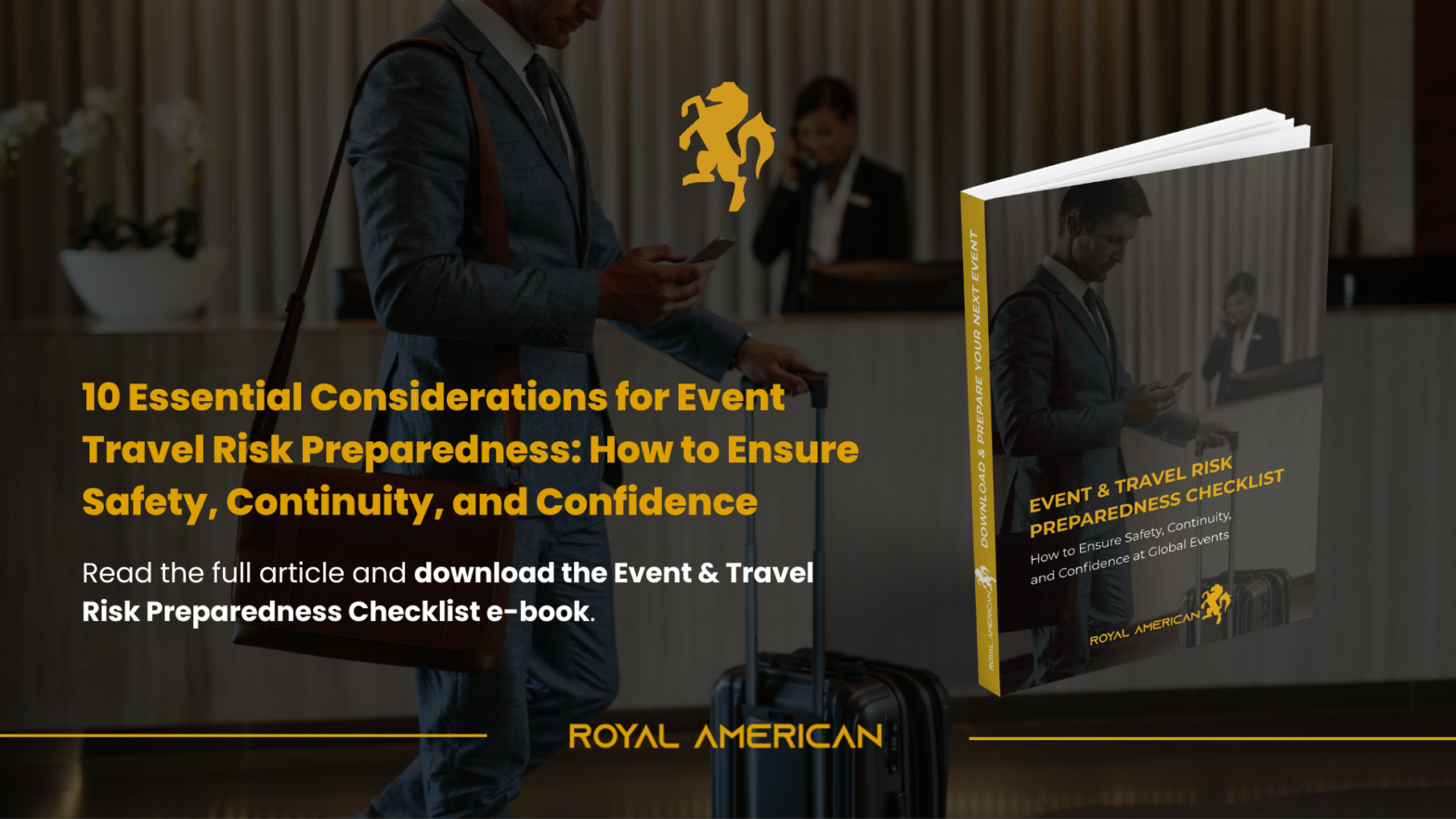
17th March 2026The Growing Importance of Travel Risk Preparedness for Global Events In today’s global business landscape, international conferences, summits, and corporate events are critical touchpoints for decision-making and brand presence. Yet, every trip—no matter how meticulously planned—carries inherent risk. From political instability and health crises to logistical disruptions and cyber threats, modern event travel requires strategic …
10th March 2026When Crisis Becomes the Operating Environment For multinational organizations, crises are no longer isolated events. Hurricanes, earthquakes, political instability, and infrastructure failures increasingly intersect with global operations, executive travel, and critical business events. When disruption occurs at scale, the question is no longer if plans will fail—but how quickly organizations can regain control. In post-disaster …
3rd March 2026Why Global Cities Demand a Different Security Mindset Major metropolitan centers are engines of global business. They concentrate capital, talent, infrastructure, and decision-making power. At the same time, they also concentrate risk. Dense urban environments combine elevated crime exposure, unpredictable mobility conditions, political demonstrations, and constant public visibility—particularly for senior executives. When multinational organizations convene …
24th February 2026Why Executive Travel Becomes a Strategic Risk During Market Expansion Global expansion is rarely limited to market analysis and commercial opportunity. When organizations enter emerging markets, especially in regions with complex security dynamics, executive travel itself becomes a strategic risk variable. For technology companies operating at the intersection of innovation, intellectual property, and geopolitical exposure, …
17th February 2026Why Workforce Mobility Has Become a Strategic Risk Function As organizations expand into complex and high-variability regions, workforce mobility is no longer a logistical consideration—it is a strategic risk function. Business travel now involves a broad spectrum of employees, from senior leadership and technical specialists to operational and corporate staff, all operating under diverse and …
Continue reading “Risk Management: Building Organizational Resilience in Complex Regions”
10th February 2026In today’s volatile global environment, organizations that send employees across borders expose themselves to a spectrum of risks—political instability, health crises, crime, disruptive infrastructure, and more. A well‑designed corporate travel security policy acts as your front line of defense: it codifies expectations, aligns stakeholders, and ensures that travel doesn’t become a liability. In this guide, …
Continue reading “How to Create a Corporate Travel Security Policy”
3rd February 2026When organizations or C‑level individuals travel, they often face a choice: hire an executive driver (a premium chauffeur) or contract secure transportation (a protection‑oriented service). On the surface, both might look similar — a high-end vehicle, a professional driver — but beneath that veneer lies a deep divide in purpose, risk mitigation, and operational design. …
Continue reading “Secure Transportation vs. Executive Driver: The Key Differences You Need to Know”
27th January 2026Every global business trip carries uncertainty. Even in stable nations, hidden risks such as disease outbreaks, infrastructure failures, civil unrest, or intelligence surveillance can emerge. Without a structured risk analysis, what seems like a routine journey can become a liability. This guide is designed for travel managers, security officers, and executive mobility teams who want …
Continue reading “Risk Analysis for International Business Travel: A Step‑by‑Step Guide”
20th January 2026In 2025, executives remain prime targets not only for physical attacks — but for digital intrusion, impersonation, and reputation manipulation. In fact, 72% of C‑suite executives have experienced cyberattacks, yet many lack tailored protection on their personal devices and profiles. As a CEO, your digital life is deeply entwined with your corporate one: emails, financial …
Continue reading “The CEO’s Guide to Personal Digital Security & Reducing Online Exposure”
13th January 2026Large-scale corporate events and roadshows carry enormous opportunity—and immense risk. When security is treated as an afterthought, vulnerabilities emerge: reputational damage, safety incidents, logistical chaos, legal exposure. But when it’s integrated from the start, security becomes an enabler—not a hindrance. This article maps a full, strategic framework for how to embed security in every phase: …
Continue reading “Integrating Security into Large‑Scale Events & Roadshows: A Master Guide”
6th January 2026When your employees travel for business, your responsibilities extend far beyond booking flights and accommodations. In many jurisdictions—and increasingly in corporate governance—companies carry a duty of care to protect their staff from foreseeable harm while on the road. Fail in doing so, and legal, reputational, and human costs follow. In this article, we’ll unpack what …
Continue reading “Understanding Your Duty of Care Obligations for Employees on Business Travel”
30th December 2025Armored vehicles are often perceived as symbols of prestige or deterrence, but in many corporate or executive security programs, they are functionally essential. Used well, they become a strategic asset — not just a status item. This article explores the conditions under which armored vehicles are justified, regional differences in necessity, and how Royal American …
Continue reading “The Role of Armored Vehicles in Corporate Security: When and Why”
23rd December 2025Non‑Emergency Medical Transportation (NEMT) is a crucial service for clients who require safe, reliable, medical-aware mobility—without the immediacy of an ambulance. For companies that handle medical logistics, clinical trials, long-distance transfers, or patient support globally, choosing the right NEMT partner is a critical decision. This article presents a full roadmap of criteria, operational standards, regional …
Continue reading “What to Look for in a Non‑Emergency Medical Transportation (NEMT) Provider”
16th December 2025In a world defined by volatility—geopolitical upheaval, extreme weather, pandemics, social unrest—even the most global, well-resourced organizations can be caught off guard. For companies operating across borders with dispersed teams, the ability to respond to crises and execute safe evacuations is not a luxury—it’s essential. Failures in these domains lead to human risk, reputational damage, …
Continue reading “Crisis Response & Evacuation Planning for Global Teams: A Full Reference Guide”
9th December 2025In today’s borderless world, security is no longer defined solely by armored vehicles, encrypted radios, or tactical readiness. The true differentiator of a successful global operation lies in something far less visible — Cultural Intelligence (CQ). While many organizations invest heavily in physical protection and technology, few recognize that one poorly chosen gesture, word, or …
2nd December 2025In today’s corporate environment, security needs are evolving faster than ever — and so are the ways companies meet them. Hiring full-time security personnel can be costly, rigid, and inefficient for many organizations. That’s where Fractional Security comes in: a flexible, on-demand solution designed for companies that need high-level protection without the overhead of a …
26th November 2025From Reaction to Prophecy in Protection Executive protection is transforming. The old paradigm — rely on human vigilance, fixed routines, and reactive defense — is giving way to a new model powered by data, intelligence, and anticipatory systems. With threats scaling in complexity — deepfakes, coordinated cyber-physical attacks, geopolitical instability, insider risk — protective programs …
19th November 2025Metrics that move from data to decisions in executive protection. Introduction In the realm of executive protection and strategic security services, data without insight is useless. A threat assessment is only as powerful as the metrics it uses to guide decisions. For over a decade, at Royal American, we’ve refined a suite of seven core …
3rd November 2025Executive Protection Explained: Complete Guide for Business Introduction In an increasingly unpredictable world, even the most global-minded companies are vulnerable to threats. A single security incident—kidnapping, assault, targeted violence—can derail operations, harm reputations, and incur enormous costs. For senior executives, the exposure is even greater. Executive Protection is not just a bodyguard standing next to …
Continue reading “What Is Executive Protection? A Complete Guide for Modern Companies”
3rd November 2025Everything executives and corporate travel teams need to know before crossing borders. In an increasingly complex global environment, business travel is no longer a simple matter of booking flights and arranging hotel pickups. For executives, VIPs, and high-value operations, international travel introduces a spectrum of risks — from geopolitical instability to logistical failures and reputational …
Continue reading “The Ultimate Security Checklist for International Business Travel”
28th October 2025When most people hear the term Executive Protection, they picture a stern figure in a black suit, standing next to a CEO or public official. But in today’s global landscape — marked by geopolitical tensions, reputational threats, and unpredictable crises — that image is not only outdated; it’s dangerously incomplete. Executive Protection is not about …
Continue reading “Executive Protection: Beyond Bodyguards — A Strategic Approach to Risk Management”
17th October 2025Modern Executive Protection demands more than presence — it requires predictive power. In today’s volatile global environment, protecting high-level executives, diplomats, and decision-makers is no longer just about physical presence. It’s about information superiority — the ability to see ahead, adapt early, and prevent threats before they materialize. At Royal American, we integrate Threat …
Continue reading “How We Integrate Threat Intelligence into Protection Planning for Global Leaders”
4th October 2025Discover how Royal American Group ensures security at major events through strategic intelligence, coordination, and discretion. In an era where global events bring together thousands of high-profile guests, world leaders, and multinational corporations, ensuring security isn’t just about having a presence. It’s about planning for every possible scenario with surgical precision. At Royal American Group, …
23rd September 2025In the world of executive mobility and high-stakes travel, no two regions are alike. From urban centers with political unrest to remote territories with infrastructure limitations, operating globally means navigating constant variables. At Royal American Group, we deliver consistent, elite-level service in every mission thanks to our extensive network of over 5,000 vetted partners—across more …
19th September 20251. Introduction: Why Businesses Need a New Approach to Risk In an era of global volatility, fragmented risk management is no longer enough. From cyber threats to political instability and operational disruptions, risks are increasingly interconnected—and so must be your approach to managing them. That’s where Enterprise Risk Management (ERM) comes in. ERM isn’t just …
11th September 2025When we think about travel disruptions, it’s easy to focus on the visible costs—like a canceled flight or an extra hotel night. But in reality, the cost of travel risk incidents goes much deeper. From reputational damage to productivity loss and health risks, each disruption silently chips away at your company’s performance, morale, and financial …
Continue reading “The Hidden Cost of Travel Incidents — And the Strategies to Avoid Them”
3rd September 20251. Why Travel Safety Starts Before Departure Many companies still see travel safety as a reactive measure—only stepping in when something goes wrong. But this outdated mindset often leads to costly disruptions, damaged reputations, and compromised operations. In truth, travel safety begins long before departure. It starts with assessing the risks, understanding the environment, and …
21st August 2025In today’s high-risk global environment, executive travel isn’t just a logistical operation—it’s a strategic mission. For many companies, the true value of travel security lies not in what’s visibly spent, but in what’s intelligently prevented. The idea that security is merely a cost center is outdated. With rising geopolitical, health, and infrastructure risks, companies are …
Continue reading “Measuring the ROI of Risk Management in Executive Travel”
13th August 2025In today’s unpredictable global environment, ensuring employee safety during business travel has evolved far beyond booking flights and hotels. Executives and travel teams now face a critical obligation: to implement robust, actionable frameworks that safeguard their personnel before, during, and after international mobility. This is where the concepts of duty of care and travel risk …
Continue reading “Duty of Care in Travel Risk Management: Real Solutions for Modern Companies”
8th August 20251. Introduction: From Protocol to Strategic Imperative Global risk is no longer theoretical. Organizations today face real, tangible disruptions: geopolitical instability, civil unrest, health crises, infrastructure failure, and climate-driven emergencies. In this environment, corporate duty of care is no longer just a legal formality—it’s a strategic asset. Modern executives understand that safety is not a …
Continue reading “Corporate Duty of Care: A Strategic Layer in Global Risk Management”
28th July 2025Why Risk Mitigation Matters More Than Ever In a world shaped by geopolitical tensions, unpredictable disruptions, and rapid social shifts, business travel now demands more than just logistics—it requires strategic foresight. For organizations operating globally, risk mitigation is no longer optional. It’s a critical layer of protection that safeguards not only people, but also business …
Continue reading “Real-World Risk Mitigation: Strategies That Save Time, Reputation, and Lives”
28th July 2025What Is Travel Risk Management and Why It Matters for Your Company Business travel may seem routine—until something goes wrong. Flight delays, political protests, health emergencies, or even minor logistical issues can jeopardize an entire executive mission. That’s where travel risk management comes in. It’s not just a checklist—it’s a strategic framework of planning, risk …
Continue reading “Travel Risk Management: How to Protect Executives with Strategy and Precision”
16th July 2025Why Duty of Care Matters More Than Ever In today’s volatile global environment, sending an employee abroad is more than a logistical arrangement, it’s a corporate responsibility. From geopolitical instability to regional health crises and organized crime, international mobility is increasingly complex. For HR managers, COOs, and travel directors, fulfilling the Duty of Care is …
Continue reading “Duty of Care in International Travel: What Companies Can’t Overlook”
8th July 2025Understanding Executive Security in Latin America’s Complex Landscape Latin America is a region of profound contrasts — politically, socially, and economically. Countries such as Venezuela, Brazil, and Colombia are often marked by institutional instability, widespread protests, and under-resourced public security agencies. These conditions make executive security in Latin America uniquely challenging and demand adaptive, intelligence-based …
1st July 2025Corporate security in 2025 is evolving rapidly amid a more unstable, interconnected global landscape. As we approach the second half of the year, geopolitical friction, emerging technologies, and shifting regulatory demands are reshaping how organizations protect people, reputations, and operations. At Royal American Group, we believe preparation is the most powerful form of protection. In …
Continue reading “Corporate Security 2025: What to Expect in the Second Half of the Year”
12th June 2025As we navigate the complexities of 2025, corporate security is no longer a support function—it has become a strategic pillar. In a world shaped by escalating geopolitical risks, sophisticated cyber threats, and operational uncertainty, businesses must adopt a proactive and adaptive security posture. At Royal American Group, we operate across more than 1,000 cities globally. …
Continue reading “Corporate Security Trends for 2025: What Global Companies Need to Know”